Capacitors: capacitance, energy and dielectrics
Capacitance and the parallel-plate capacitor with proof, series and parallel, stored energy, dielectrics and polarisation with a table of materials, real capacitors.
The capacitor is the component that stores charge and energy in an electric field. An electronic board holds dozens or hundreds of them: for filtering supplies, coupling stages, timing, tuning. In this lesson we cover capacitance, the parallel-plate capacitor, series and parallel connections, stored energy and the role of the dielectric.
Capacitance
Two conductors insulated from each other, with charges  and
 , have a potential difference
 proportional to
 . The ratio is the capacitance:
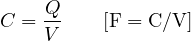
It depends only on the geometry and on the material between the conductors, not on the charge. The farad is a huge unit: common capacitors range from picofarads (pF) to millifarads, and only supercapacitors reach thousands of farads.
The parallel-plate capacitor
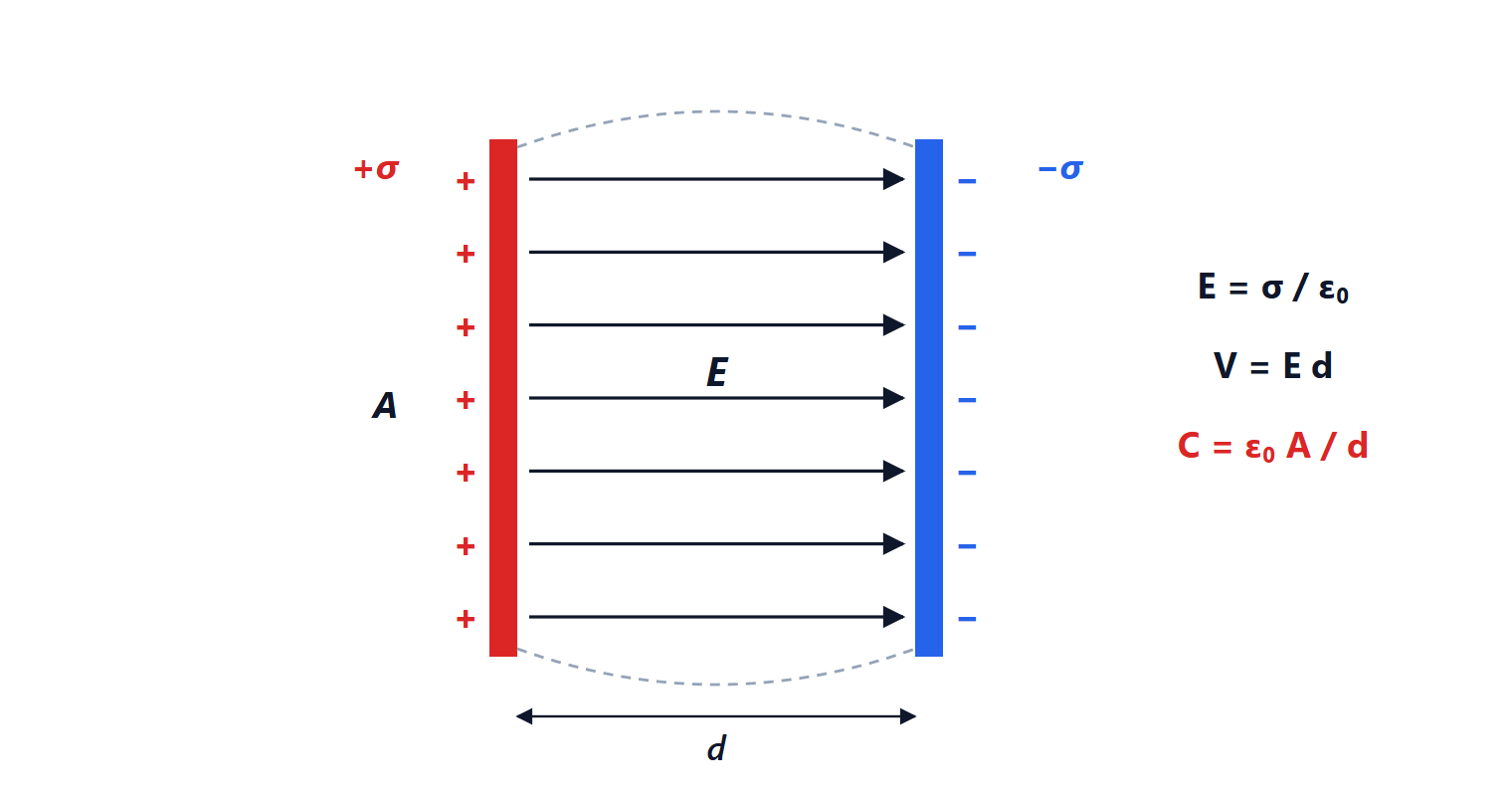
Proof of the formula
From Gauss’s law (lesson on the electric field) the field between two planes with densities  is
 , uniform. The potential difference is
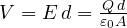 . So
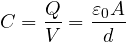
Capacitance grows with area and falls with distance. Example: two 10 cm × 10 cm plates 1 mm apart in air have  pF. To reach 1 µF you would need plates 10 m on a side: that is why real capacitors use very thin dielectrics with a high permittivity, wound or stacked.
Other geometries: the cylindrical capacitor (a coaxial cable of length  ) has
 ; the spherical capacitor
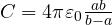 . An RG-58 coaxial cable has about 100 pF per metre.
Series and parallel connections
- Parallel: same voltage, the charges add:
 It is like increasing the plate area.
- Series: same charge on each capacitor, the voltages add:
 It is like increasing the distance. Two equal capacitors in series have half the capacitance but withstand twice the voltage.
They are the opposite of the rules for resistors.
Stored energy
Charging a capacitor means carrying charge from one plate to the other against a rising voltage. When the charge is  the voltage is
 , and the work to add
 is
 . Integrating from 0 to :

For the parallel-plate capacitor,  : the energy density
 times the volume between the plates. The energy really is in the field.
Example. A camera flash capacitor, 470 µF charged to 330 V, holds  J, dumped into the tube in a millisecond: a peak power of tens of kilowatts. It is also why power supply capacitors must be discharged before you put your hands in.
Dielectrics
Inserting an insulator between the plates increases the capacitance by a factor  , the relative permittivity:
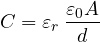
The reason is polarisation: the field aligns the dipoles of the molecules (or creates them, by distorting the atoms), and the bound charges appearing on the faces of the dielectric reduce the internal field by a factor . For the same charge the voltage drops, so the capacitance rises.
| Material | | Typical use |
|---|---|---|
| air | 1.0006 | variable capacitors |
| polypropylene | 2.2 | film capacitors, audio and power |
| FR-4 fibreglass | about 4.4 | printed circuit boards |
| aluminium oxide | about 9 | electrolytic capacitors |
| tantalum oxide | about 26 | tantalum capacitors |
| barium titanate ceramics | from 1000 to over 10,000 | multilayer ceramic capacitors |
Real capacitors
A multilayer ceramic capacitor (MLCC) stacks hundreds of dielectric layers a few micrometres thick, alternating with electrodes, and so packs microfarads into a one-millimetre cube. An electrolytic uses as dielectric a layer of aluminium oxide nanometres thick, grown on a foil etched to multiply its area; that is why it has a polarity to respect.
A real capacitor is not ideal: it has a series resistance (ESR) and a series inductance (ESL), and high- ceramics lose much of their capacitance when a DC voltage is applied. These details are read in datasheets and they matter when designing a power supply.