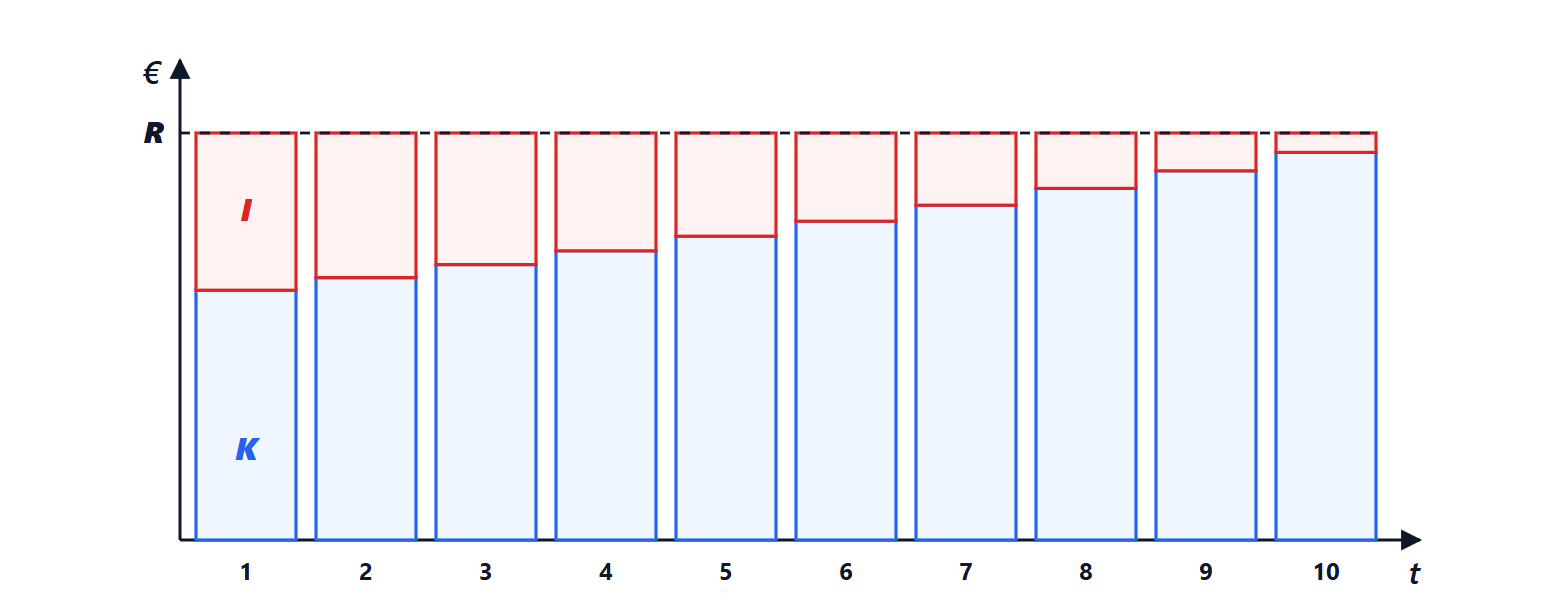
Investment appraisal: NPV, IRR and payback
Discounting, net present value, the annuity formula proved, a complete example with IRR and payback, comparison of criteria, inflation and sensitivity.
A new production line, a photovoltaic plant, the development of a new product: an investment costs money today and pays back in future years. To decide, money at different times must be compared, and a euro today is worth more than a euro in five years. In this lesson we look at discounting, net present value, the annuity formula with its proof, a complete example with the internal rate of return and payback, and the pitfalls of the various criteria.
The time value of money
A euro invested today at rate  is worth
 after
 years (compound interest). Conversely, a euro that will arrive in years is worth
 today: this is the present value, and is the discount rate, the return obtainable with an alternative investment of equal risk (the opportunity cost of capital, lesson on financing).
Net present value
An investment is described by the sequence of its cash flows  (usually
 , the initial outlay). The net present value is
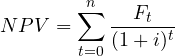
The investment pays if  : it earns more than the alternative, and the NPV is precisely the extra wealth created, valued today. Cash flows (receipts and payments) are used, not profits: depreciation is not a cash outflow (lesson on financial statements), whereas buying the machine is.
Annuities
Many investments produce constant flows. The discounted sum can be computed in closed form.
Theorem. The present value of  constant flows
 at the end of each year is
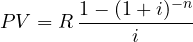
Proof.  with
 . It is a geometric progression:
 . Since
 , we have
 , and hence
 . ∎
For  the value tends to
 : a perpetuity is worth the flow divided by the rate.
A complete example
Example. A machine costs 100,000 euros and saves 25,000 euros a year for 6 years, with a discount rate of 8 %. The annuity factor is  , so the savings are worth about 115,600 euros today and

The investment creates value.
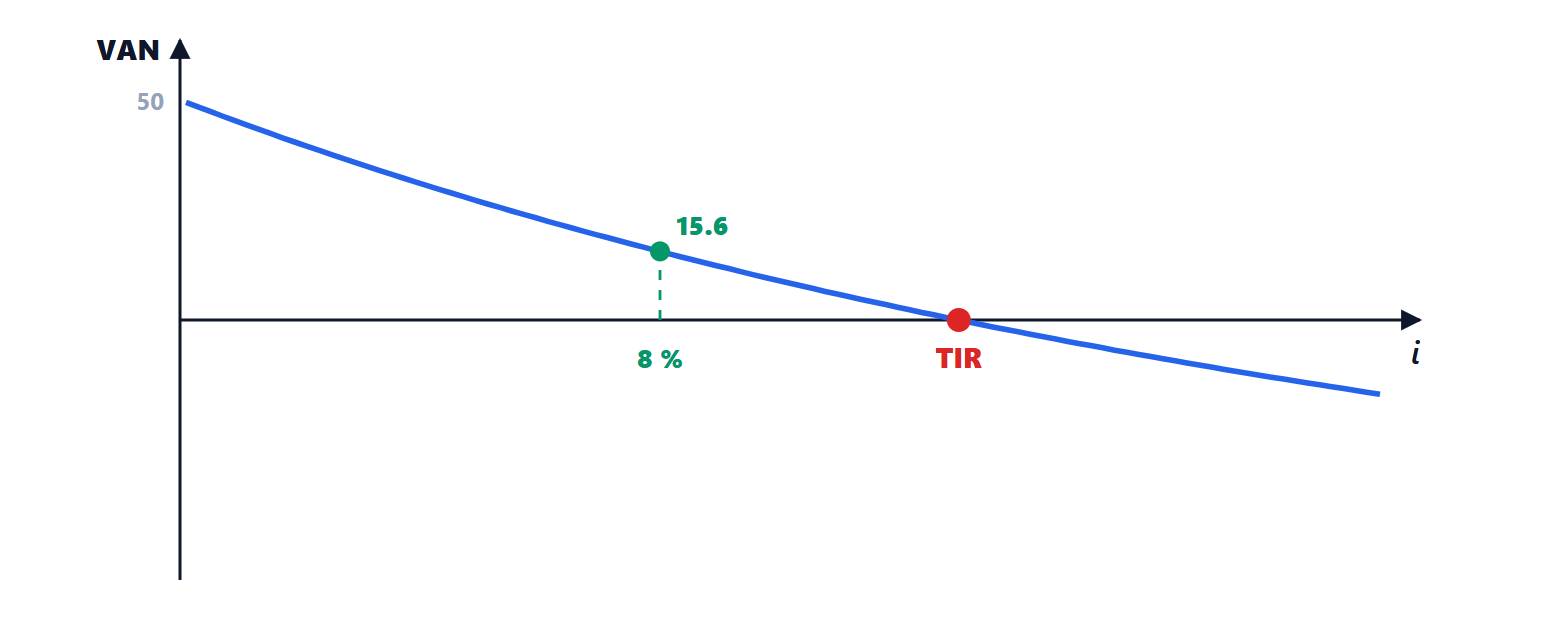
The internal rate of return (IRR) is the rate that makes the NPV zero: here an annuity factor of 4 is needed, corresponding to about 13 %. The project pays if the IRR exceeds the cost of capital. The payback period is the number of years needed to recover the outlay: here 4 years (without discounting).
The criteria compared
- NPV is the correct criterion for creating value: it is additive (the NPV of two projects is the sum) and takes size into account.
- IRR is intuitive, because it is a rate, but it can mislead: between two alternative projects it may prefer the small one with a high return to the large one that creates more value; and if the flows change sign several times (a plant with final decommissioning costs) the equation may have several solutions.
- Payback ignores flows after recovery and the time value of money, but measures liquidity risk: in fast-changing sectors, such as consumer electronics, recovering quickly matters.
Two practical cautions. Inflation: rates and flows must be consistent, both nominal or both real, with  . Uncertainty: future flows are estimates, and it pays to compute the NPV under different scenarios, or the change in NPV as the main assumptions vary (sensitivity analysis), to see which estimates really matter.