Financing: amortisation schedule, WACC and Modigliani-Miller
The French schedule instalment proved with an example, weighted average cost of capital and tax shield, the Modigliani-Miller theorem by arbitrage, sources of finance.
A profitable investment (lesson on investments) must also be financed: with the shareholders’ capital, bank loans, bonds, leasing. Each source has a different cost and risk. In this lesson we look at the amortisation schedule of a loan with the proof of the instalment and an example, the weighted average cost of capital with the tax shield, the Modigliani-Miller theorem with the arbitrage argument, and the most common sources of finance.
The constant-instalment loan
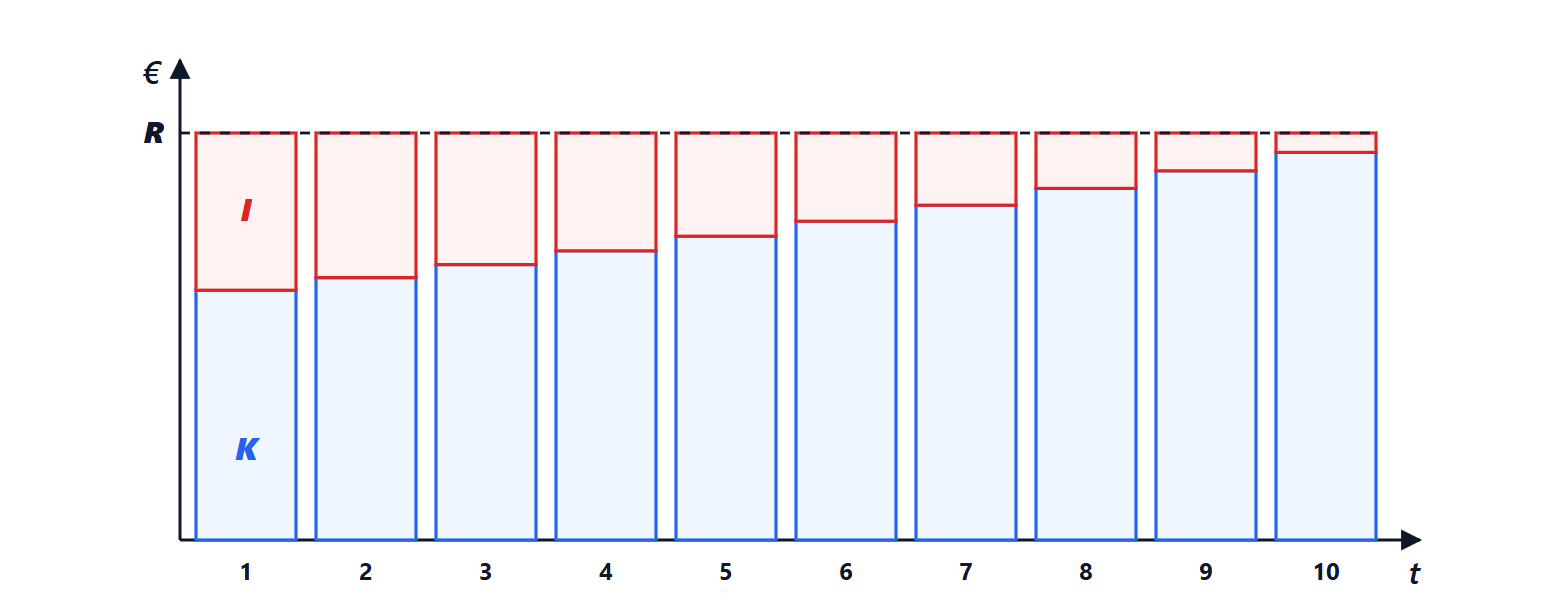
A mortgage or bank loan is usually repaid with the French (annuity) schedule: constant instalments comprising an interest share, computed on the outstanding debt, and a principal share.
Theorem. A debt  at rate
 is repaid in
 constant annual instalments
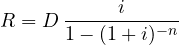
Proof. The loan is fair if the present value of the instalments, at the loan rate, equals the capital received. By the annuity formula (lesson on investments),  , hence the formula. ∎
Example. 100,000 euros at 5 % over 10 years: the annuity factor is  , and the instalment is about 12,950 euros. In the first year interest is
 and principal 7950; the debt falls to 92,050, the next year’s interest is lower and the principal share higher. In total 129,500 euros are paid, of which 29,500 interest.
The cost of capital
The company is financed with equity  and debt . Shareholders expect a return
 , higher than that of creditors
 because they are paid last and bear more risk. Interest on debt is tax-deductible: every euro of interest reduces taxes by
 euros, with the tax rate. The weighted average cost of capital is

It is the rate at which to discount the flows of an investment with risk similar to the company’s average: a project creates value if it earns more than the WACC.
Example. 60 % equity with  %, 40 % debt with
 %, tax rate 24 %:
 %.
The term  is the debt’s tax shield: a debt at rate saves
 in taxes every year.
The Modigliani-Miller theorem
It seems that debt, costing less than equity, always lowers the average cost. Modigliani and Miller (1958) showed that this is not so, at least in an ideal world.
Theorem (Modigliani and Miller, without taxes). In a perfect market, without taxes, without bankruptcy costs and where everyone can borrow and lend at the same rate, the value of a company does not depend on how it is financed.
Argument. Consider two companies with the same future operating flows:  without debt and
 with debt . An investor buying a fraction
 of ‘s shares receives times the operating flows minus interest. Exactly the same flows can be obtained by buying of ‘s shares and personally borrowing
 on the same terms (“home-made” leverage). Two positions with identical flows must cost the same, otherwise one would earn without risk by buying the cheaper and selling the dearer (arbitrage). So (value of ‘s shares)
 (value of )
 , i.e. the value of ‘s shares plus its debt equals the value of . ∎
The consequence is that the return required by shareholders rises with debt just enough to offset the cheaper debt (the leverage of the lesson on ratios seen from the risk side), and the average cost stays constant. In the real world the exceptions matter: the tax shield makes debt attractive; financial distress costs (loss of customers and suppliers, legal costs) make it expensive when there is too much. The optimal structure is a compromise between the two.
Sources of finance
- Equity: shareholder contributions, capital increases, retained earnings (self-financing); for young companies, venture capital betting on growth in exchange for a stake.
- Bank debt: medium and long-term loans for investments; credit lines and invoice advances for working capital (lesson on budgeting and cash).
- Bonds: loans raised on the market, for larger companies.
- Leasing: an asset is used by paying instalments, without buying it; for the financial statements it is essentially a debt.
- Public grants and tax credits for research, innovation and energy efficiency, which reduce the effective cost of investments.
The underlying rule is matching maturities (lesson on financial statements): long-term investments with long-term sources, working capital with short-term sources.