Financial statements: reclassified balance sheet and income statement
Balance sheet by liquidity, structural margins and net working capital, value-added income statement with an example, depreciation, change in equity proved.
The annual financial statements are the document with which a company tells shareholders, banks, suppliers and the tax authorities about its situation every year. To read them they must be reclassified, i.e. their items rearranged according to the question of interest: is it solid? is it liquid? does it make money? In this lesson we look at the reclassified balance sheet with structural and liquidity margins, the value-added income statement with an example, depreciation, and the proof of the link between profit and equity.
The parts of the financial statements
Under the Italian Civil Code the financial statements comprise the balance sheet (the snapshot of assets, liabilities and equity at year end), the income statement (the year’s costs and revenues), the cash flow statement and the notes. Listed companies use the international accounting standards (IFRS), with somewhat different layouts but the same logic.
The reclassified balance sheet
To judge financial balance, assets are ordered by the time they take to turn into cash and sources by maturity:
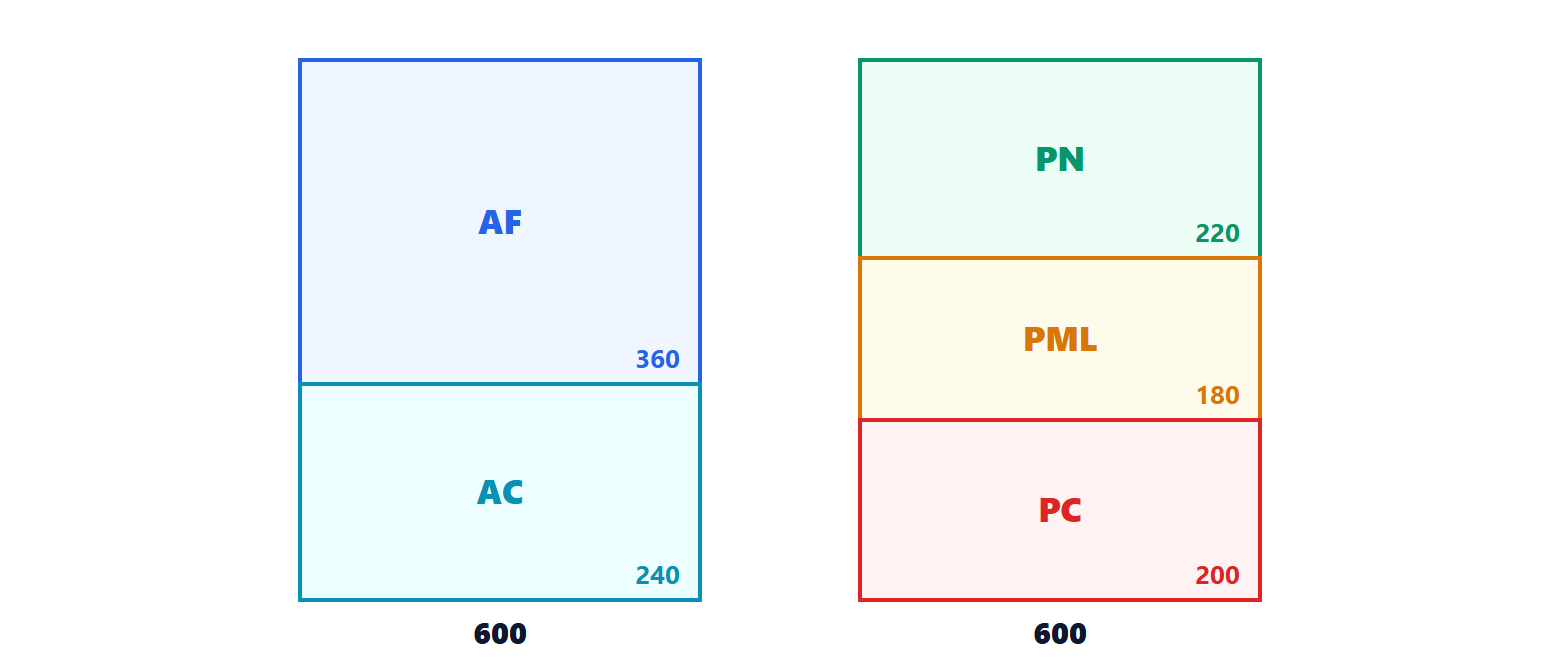
- fixed assets (AF): goods remaining beyond the year, such as plant, patents, shareholdings;
- current assets (AC): inventory, trade receivables, cash, which turn back into money within the year;
- equity (PN), medium and long-term liabilities (PML) and current liabilities (PC), due within the year.
The rule of good health is that long-term uses are financed by long-term sources. In the example:
- structural margin:
 : own capital is not enough to cover fixed assets; with long-term debt,
 : fixed assets are covered by long-term sources;
- net working capital:
 , the same number seen from the other side, and current ratio
 : the assets that will become cash within the year exceed the debts due within the year.
That the two margins coincide is no accident: since the totals are equal,  .
The value-added income statement
The income statement is reclassified to show how the result forms, layer by layer. Example (in thousands of euros):
| Item | Amount |
|---|---|
| Sales revenue | 1000 |
| less materials and services consumed | −550 |
| = Value added | 450 |
| less personnel costs | −250 |
| = Gross operating margin (EBITDA) | 200 |
| less depreciation and provisions | −80 |
| = Operating result (EBIT) | 120 |
| less financial charges | −20 |
| = Result before taxes | 100 |
| less taxes | −30 |
| = Net result (RN) | 70 |
Value added is the wealth created by the company over what it buys; EBITDA measures the ability of core operations to generate resources, before choices on depreciation and financing; the operating result is what the business earns, regardless of how it is financed, and is the basis of profitability ratios (lesson on ratios).
Depreciation
By the accrual principle (lesson on the company), the cost of a durable asset is spread over the years in which it is used. With the straight-line method:

A machine costing 30 with a 5-year life and zero residual value costs 6 a year. Depreciation is a cost that does not involve a cash outflow in the year: this is why EBITDA, which precedes it, is close to operating cash flow.
Profit and equity
Theorem. Between the beginning and end of a year, the change in equity is

Proof. Revenues and costs are recorded as increases and decreases in equity (lesson on the company), and their algebraic sum is the net result  . The only other transactions affecting equity are those with shareholders: dividends reduce it, contributions increase it. All other transactions, such as buying an asset with a loan, change assets and liabilities without touching equity. Adding up gives the formula. ∎
In the example, if of the profit of 70, 30 is distributed as dividends and the shareholders contribute nothing, equity grows by 40. This is self-financing: the most common source of company growth.