The company, accounting and double entry
Company, business and stakeholders, legal forms, balance-sheet and income accounts, preservation of the balance-sheet identity by double entry proved, the accrual principle.
An engineer spends much of a career inside a company: designing products that must fit a budget, proposing investments that must pay off, leading departments with economic targets. Understanding how a company records and measures what it does is therefore part of the job. In this lesson we look at what a company is and its legal forms, the accounting system, the double-entry method with the proof that it preserves the fundamental balance-sheet equation, and the accrual principle.
The company and its forms
A company (business) is an organisation of people and assets producing goods or services to meet needs, in a lasting and economic way: in the long run revenues must cover all costs, including an adequate return on the capital invested. Around it are the stakeholders: shareholders, lenders, employees, customers, suppliers, the State, the local community.
The legal form establishes who is liable for debts and how the company is governed: the sole proprietorship and partnerships, where at least some partners are liable with their personal assets; limited companies (private limited, public limited), where liability is limited to the capital contributed and the company has its own legal personality; cooperatives, with a mutual purpose.
The accounting system
Every transaction with the outside world (purchases, sales, payments, loans) leaves a numerical trace in financial accounting, which is used to draw up the financial statements (lesson on financial statements). Amounts are recorded in accounts, each with two columns: debit (left) and credit (right).
- Balance-sheet accounts describe what the company owns and owes: assets
 (plant, inventory, receivables, cash), liabilities
 (debts to banks, suppliers, employees) and equity
 (the shareholders’ capital plus retained earnings).
- Income accounts describe the costs and revenues of the period, which at the end are closed into the result, the profit or loss, which goes into equity.
Double entry
The basic rule, codified by Luca Pacioli in 1494, is that every transaction is recorded twice, as a debit in one account and a credit in another, for the same amount. By convention an increase in assets or a cost is recorded as a debit; an increase in liabilities or equity, or a revenue, as a credit.
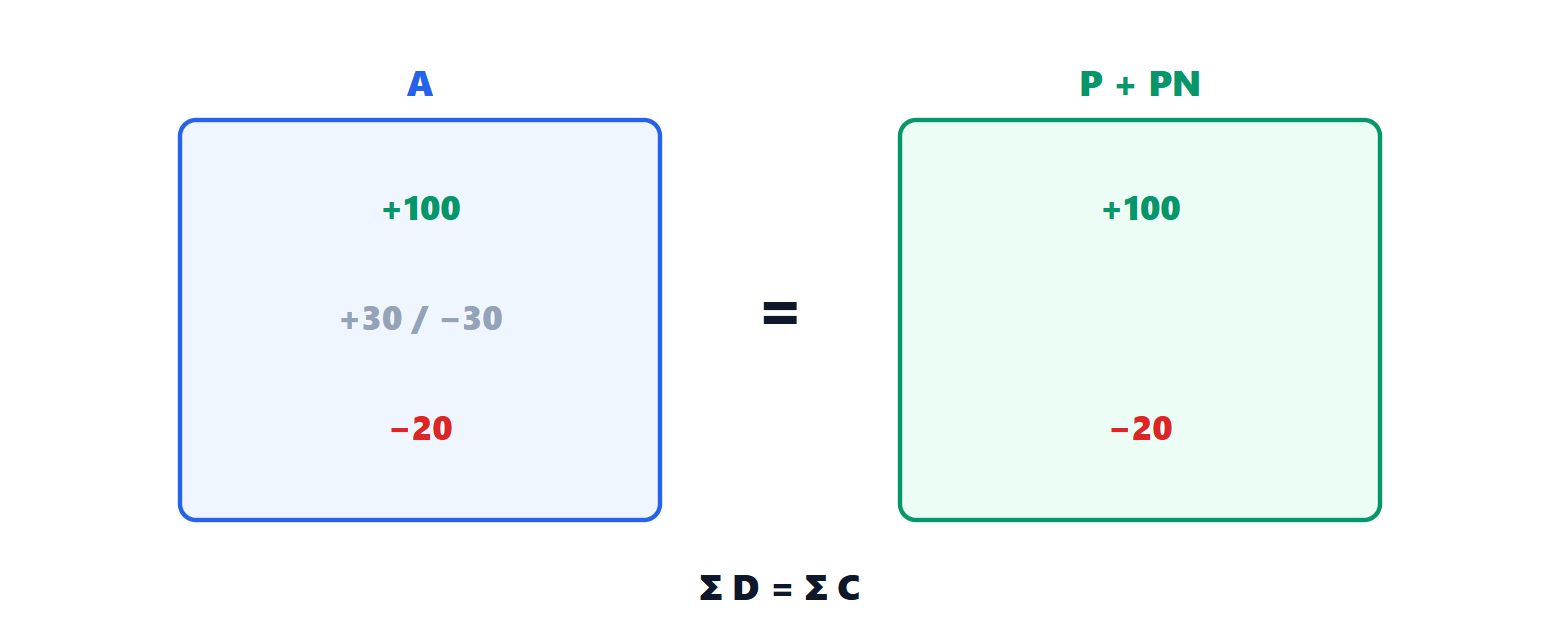
Theorem. If every entry has debits equal to credits, the balance-sheet identity

remains true after any sequence of transactions (counting costs and revenues as decreases and increases in equity).
Proof. At the start, before any transaction, all accounts are zero and the identity holds. In each entry, a debit amount increases an asset or decreases a liability or equity (a cost is a decrease in equity); a credit amount does the opposite. So the change in  equals the sum of debits minus the sum of credits of the entry, which is zero by the rule. If the difference was zero, it stays zero. ∎
Example. The shareholders contribute 100 to the bank: debit Bank 100, credit Capital 100; assets and sources rise to 100. A machine is bought for 30, paid from the bank: debit Machinery 30, credit Bank 30; assets change composition but not total. A rent of 20 is paid: debit Rent expense 20 (a cost, reducing equity), credit Bank 20; assets and sources both fall to 80.
The method also has a control function: if at the end the sum of all debits does not equal that of all credits, there is a recording error. Today double entry is automatic in management systems (ERP), but the logic is the same.
The accrual principle
The result of a period is not the difference between receipts and payments, but between the revenues and costs accrued to the period: a cost belongs to the period in which it helps produce revenues, not to the one in which it is paid. A machine lasting five years is not a cost entirely in the year of purchase: its cost is spread over the years of use through depreciation (lesson on financial statements). A sale made in December and collected in February is December revenue, and meanwhile remains a receivable. This is why a company can be in profit and run out of cash, or in loss with plenty of cash: liquidity management is a separate problem (lesson on budgeting and cash).