The Bolzano-Weierstrass theorem: statement and proof
Every bounded sequence has a convergent subsequence: proof by bisection, common mistakes, examples and what the theorem is used for in the rest of the course.
A bounded sequence does not have to converge:  stays between
 and
 forever without settling on any value. But if we look only at the terms in even positions we get the constant sequence
 , which converges. The Bolzano-Weierstrass theorem says this always happens: from a bounded sequence you can always extract a convergent subsequence.
Statement
Every bounded real sequence  has a subsequence
 , with
 , that converges to a real number
 .
A subsequence is obtained by choosing infinitely many terms of the sequence in the order in which they appear: you may skip terms, but you cannot go back.
Proof by bisection
Since the sequence is bounded, all its terms lie in an interval  . The idea is to halve the interval again and again, each time keeping a half that contains infinitely many terms of the sequence.
- Split
 in half. At least one of the two halves contains
 for infinitely many indices
 (if both contained only finitely many, the sequence would have finitely many terms). Call
 a half with this property.
- Repeat: from
 get
 , half as long, still containing infinitely many terms. The length is
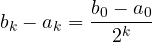 .
- Pick the indices:
 such that
 ; then
 with
 , and so on. This is always possible, because contains infinitely many terms and therefore one with an index larger than the previous choice.
The left endpoints  form an increasing bounded sequence, so they converge to a limit by the completeness of the real numbers. Also
 , because
 . Finally
 , and by the squeeze theorem
 . ∎
It is the same technique used for the intermediate zero theorem: build nested intervals, and completeness guarantees that they “point” to a real number.
A common mistake in proofs
You sometimes read: “the interval is compact, so the sequence has an accumulation point, so it has a convergent subsequence”. In a first calculus course this is circular, because the fact that closed bounded intervals are sequentially compact is the Bolzano-Weierstrass theorem. Another mistake is to pick terms “close to ” without saying how: you must make sure the indices are strictly increasing, and the bisection construction is there precisely for that.
Examples
 : the even terms give , the odd terms . Two subsequences with different limits, so the sequence does not converge.
 : it is bounded between and , and the theorem guarantees a convergent subsequence, even though finding one explicitly is not easy.
 : not bounded, and indeed no subsequence converges. The hypothesis matters.
What it is for
The theorem is one of the building blocks of first-year calculus. It is used to prove the extreme value theorem: a continuous function on a closed bounded interval has a maximum and a minimum. You take a sequence of points where  approaches its supremum, extract a convergent subsequence and use continuity. It is also used to prove that Cauchy sequences converge and, later on, that a continuous function on a closed interval is uniformly continuous.
In engineering it shows up in a less visible but constant way: whenever an iterative algorithm produces a bounded sequence of estimates (an optimisation, an adaptive filter), the theorem guarantees that at least some subsequence settles on a value. Proving that the whole sequence converges takes an extra argument.