Kirchhoff's laws, series and parallel, dividers and the Wheatstone bridge
Nodes, branches and loops, the current and voltage laws, number of independent equations, series and parallel, dividers, star-delta transformation, Wheatstone bridge.
Two laws, stated by Kirchhoff in 1845, are enough to write the equations of any circuit. Together with the relations of the individual components (Ohm’s law and the others of the lesson on two-terminal elements) they give every voltage and current. In this lesson we look at them and their physical meaning, then apply them to series and parallel connections, dividers and the star-delta transformation.
Nodes, branches and loops
- a node is a point where two or more components are connected;
- a branch is a component (or a series of components) between two nodes;
- a loop is a closed path through branches that does not pass through the same node twice.
Kirchhoff’s current law (at nodes)
The sum of the currents entering a node equals the sum of the currents leaving it. Equivalently: the algebraic sum of the currents at a node is zero.
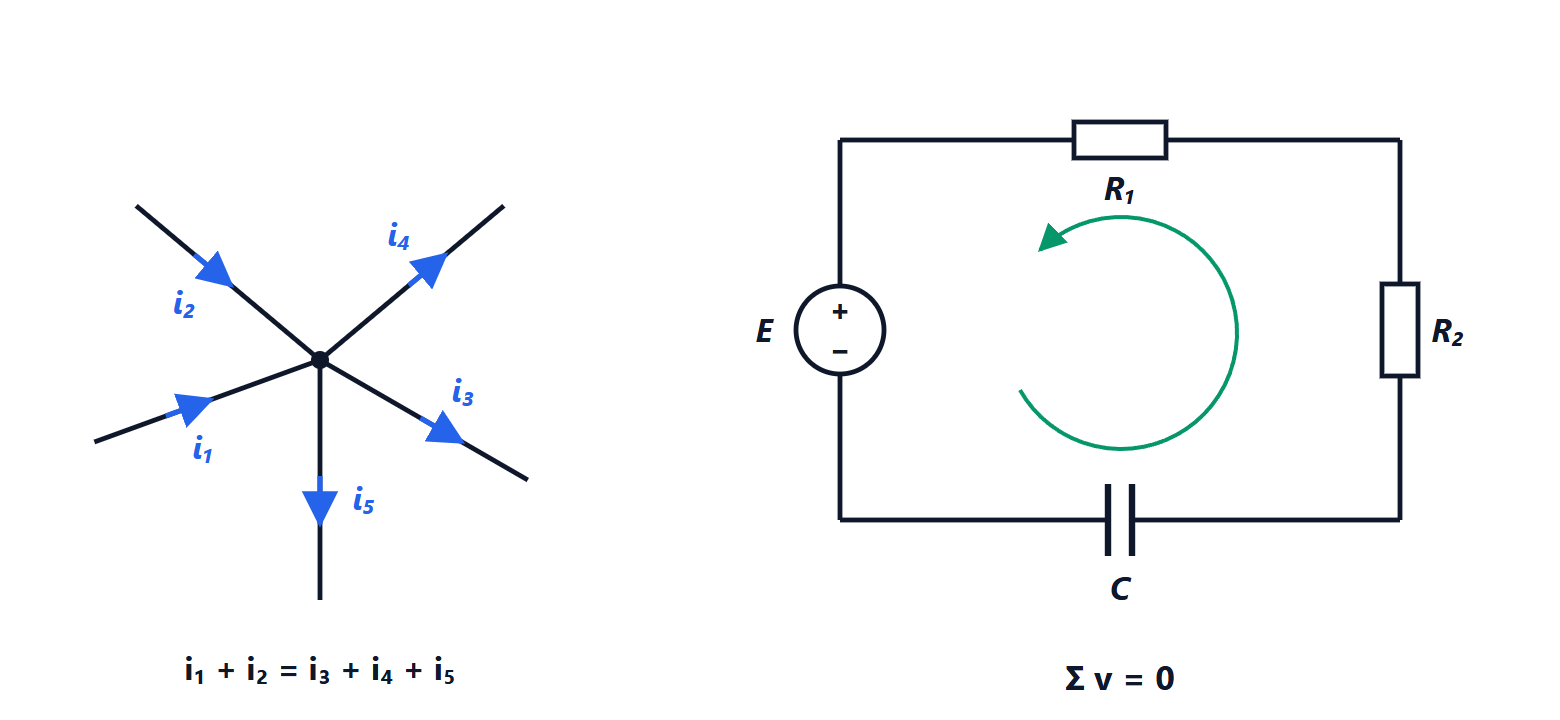
It is conservation of charge: at a node, which is a point with no capacitance, charge cannot accumulate, so as much leaves as arrives.
Kirchhoff’s voltage law (around loops)
The algebraic sum of the voltages around a loop is zero. Go round the loop in one direction, counting with a + sign the voltages whose + terminal you meet first, with a − sign the others.
It follows from the electrostatic field being conservative (Physics 2 lesson on potential): the voltage between two nodes is the difference of their potentials, and going all the way round you return to the same potential. With changing magnetic fields linked to the loop the law does not hold as it stands: the induced voltage is accounted for with inductors and mutual inductances.
How many equations are needed
A circuit with  nodes and
 branches has
 unknowns (a voltage and a current per branch). The independent equations are:
 node equations (the last is a combination of the others);
 loop equations (as many as the “independent” loops);
- component relations.
In all equations for unknowns. In the lesson on analysis methods we will see how to cut them down a lot.
Series and parallel
Series: components carrying the same current. By the voltage law the voltages add, and

Parallel: components with the same voltage. By the current law the currents add, and

The parallel resistance is always smaller than the smallest one. Two equal resistors in parallel give half.
Dividers
Voltage divider. Two resistors in series with total voltage  : the current is
 , so
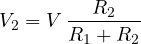
It is the most used circuit in electronics: to scale down a voltage to be read by a converter, to bias a transistor, to read a resistive sensor such as a thermistor or a photoresistor. Watch the load: if a load  is connected across
 , the ratio changes (use
 ). The divider works as intended only if the load is much larger than .
Current divider. Two resistors in parallel with total current  :
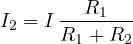
The current splits in inverse proportion to the resistances: most of it goes through the smaller resistance.
Example. A 3.3 V microcontroller must measure the voltage of a 12 V battery (up to 14.4 V while charging). With  kΩ and
 kΩ the ratio is
 , and 14.4 V becomes 3.35 V: too much, better
 kΩ (ratio 0.204, 2.94 V at most). The current drawn from the battery is
 mA.
Star and delta
Three resistors connected in star (a common node) can be replaced by three connected in delta, and vice versa, without changing the behaviour seen from the three terminals. With equal resistances the rule is simple:

In general  (from star to delta). It simplifies circuits that cannot be reduced by series and parallel, such as the Wheatstone bridge, and comes back in three-phase systems.
The Wheatstone bridge
Four resistors arranged in a bridge with a source across one diagonal and an instrument across the other. The bridge is balanced, that is the voltage across the measuring diagonal is zero, when  . With three known resistances the fourth is measured very precisely, and it is the circuit of the load cells in electronic scales and many pressure sensors: a small change in one resistance produces a proportional voltage across the diagonal.