The geometric series: when it converges and what it adds up to
Closed form of the partial sum, convergence for |r| less than 1, divergence and oscillation, examples such as 0.999... = 1, common mistakes and where it returns (Z transform, feedback).
The geometric series is the first series you meet in calculus, and one of the very few whose sum can be computed exactly. That is why it serves as a yardstick for many others: the ratio test and the root test, for example, do nothing more than compare a series with a geometric one.
Statement
Let  and
 be real numbers. The series

- converges if
 , and its sum is
 ;
- diverges (to
 or
 , depending on the sign of
 ) if
 ;
- oscillates, that is it has no limit, if
 .
The number is called the common ratio: it is the ratio between a term and the previous one.
The trick: the partial sum has a closed form
Studying a series means studying the limit of its partial sums. For the geometric series the sum of the first  terms can be computed exactly. Write

and multiply by :

Subtracting the second line from the first, all the middle terms cancel in pairs and only this is left:

The case  has to be treated separately, but it is trivial: every term equals and
 , which diverges.
Taking the limit
Everything depends on what  does as
 :
- if ,
 and therefore
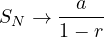 : the series converges;
- if
 ,
 and
 diverges;
- if
 , jumps between
 and
 : the partial sums alternate between and
 , so there is no limit;
- if
 , oscillates with growing amplitude and again there is no limit.
Why does  when ? A quick way: write
 with
 ; by Bernoulli’s inequality
 , so
 , which tends to zero. ∎
Three examples
1.  Here
 and
 : the sum is
 . This is Zeno’s paradox of Achilles and the tortoise: infinitely many shorter and shorter stretches can add up to a finite length.
2. Why 0.999… = 1. The repeating decimal is the series  , with
 and
 . The sum is
 . The same method gives the rule for turning any repeating decimal into a fraction.
3. A series starting at a different index.  : the first term is
 , the ratio
 , so the sum is
 . It is always better to identify the first term than to memorise a different formula for every starting index.
Common mistakes
- Using
 even when
 : with
 it would give
 , an obviously meaningless result.
- Confusing with the term of index 0 when the series starts at
 or later.
- Forgetting that can be negative:
 .
Where you will meet it again
In later courses the geometric series keeps coming back. In the Z transform the transform of an exponential  is precisely a geometric series in
 , and the condition
 defines the region of convergence. In feedback circuits the gain
 can be read as the sum of the contributions of the signal going round the loop once, twice, three times. And in an echo, or a line with multiple reflections, every pass attenuates the signal by the same factor: the total energy is again a geometric sum.



