The product rule for derivatives: proof and examples
Why the derivative of a product is not the product of the derivatives: an intuition with rectangles, the proof, examples, the quotient rule and an application to electrical power.
The derivative of a sum is the sum of the derivatives. It is tempting to think the same holds for a product, that 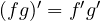 . It does not, and one example is enough to see it: with
 the product is
 , whose derivative is
 , while
 . The correct rule is Leibniz’s:

An idea with rectangles
Think of  as the area of a rectangle with sides
 and
 . When
 increases a little, side grows by
 and side by
 . The new area is the old one plus two strips,
 and
 , plus a small corner square
 . The square is the product of two small quantities, so it is negligible compared with the strips: divide by
 , take the limit, and what remains is exactly
 .
The proof
Assume and are differentiable at . The difference quotient of the product is

The trick is to add and subtract the same term  in the numerator:

and grouping the terms:

Now let  :
 and
 by definition of derivative;
 because a differentiable function is also continuous. This is the step people often forget to justify.
By the rules for limits of sums and products we get  . ∎
Why does differentiable imply continuous? For  we can write
 . The first factor tends to
 , the second to 0, so the difference tends to 0.
Examples
 .
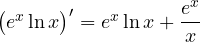 .
 , consistent with
 .
Consequences
Three or more factors. Applying the rule twice:  . Each term differentiates one factor and leaves the others alone.
Powers. With  repeated
 times you get back
 : terms, all equal to
 .
Quotients. Writing  and knowing that
 , you obtain the quotient rule
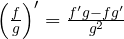 .
Integration by parts. Integrating the product rule gives  , the integration by parts method.
An example from circuit theory
The instantaneous power absorbed by a component is  . If voltage and current both change with time, the rate at which the power changes is
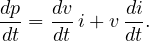
In a capacitor, where  , the stored energy
 has derivative
 , which is exactly the power: a small consistency check that goes through the product rule.