Series of functions, power series and Taylor series
Pointwise and uniform convergence, the Weierstrass M-test, radius of convergence, term-by-term differentiation and integration, Taylor series and computing integrals with series.
In Analysis 1 series were infinite sums of numbers. In Analysis 2 we add up infinitely many functions, and the result is a new function. This is how calculators compute sines and exponentials, how differential equations with no elementary solution are solved, and how signals are approximated. In this lesson we cover sequences and series of functions, uniform convergence, power series and Taylor series.
Pointwise and uniform convergence
A sequence of functions  converges pointwise to
 on a set
 if
 for every
 . It is the most natural notion, but it is weak: the functions
 on
 are all continuous, yet the pointwise limit is 0 for
 and 1 for
 , which is discontinuous.
We say converges uniformly to if

that is, if from some  on the whole graph of lies in a “strip” of width
 around the graph of , for all
 at once. In the
 example, for every there is an close to 1 where
 : the convergence is not uniform.
Why it matters
- The uniform limit of continuous functions is continuous. Given , choose with
 everywhere, then
 from the continuity of ; then
 .
- You can take the limit under the integral sign on a bounded interval:
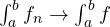 , because
 .
- Derivatives need more: uniform convergence of the derivatives
 .
For a series of functions  one studies the partial sums. The most used test is the Weierstrass M-test: if
 for every and
 converges, the series converges uniformly. Example:
 converges uniformly on the whole of
 , because
 .
Power series
A power series centred at  is
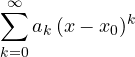
Theorem. There is  , the radius of convergence, such that the series converges absolutely for
 and does not converge for
 . The end points must be checked separately. The radius is found with the ratio or root test:

Examples.
 :
 , sum
 . It does not converge at the end points.
 : ; at
 it converges (alternating series), at it diverges (harmonic series). The sum is
 .
 :
 , sum
 .
Inside the interval of convergence the series converges uniformly on every smaller closed interval, and it can be differentiated and integrated term by term without changing the radius. For example, integrating  from 0 to gives

and at the Leibniz series: 
Taylor series
If has derivatives of every order at , its Taylor series is
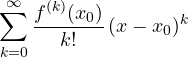
The partial sums are the Taylor polynomials of Analysis 1. The series converges to if and only if the remainder  tends to zero. With Lagrange’s remainder,
 for some
 between and .
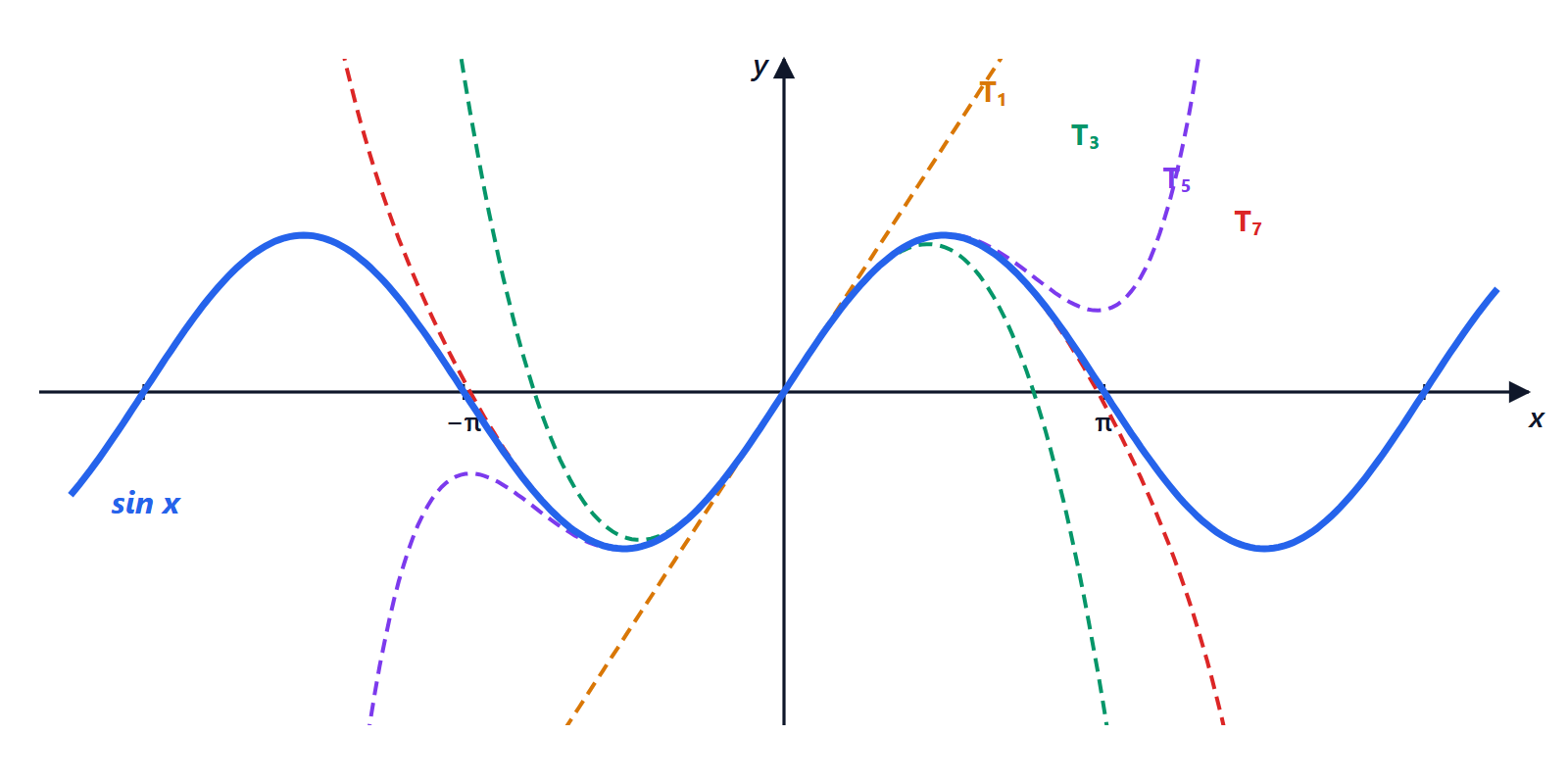
Proof: the sine series converges everywhere
Every derivative of the sine is  or
 , so
 and

because the factorial grows faster than any power. Hence

Substituting  in the exponential series and separating even and odd terms gives Euler’s formula,
 .
Careful: not every function is the sum of its Taylor series. The function 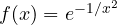 (with
 ) has all derivatives zero at 0: its Taylor series is the zero function, which equals only at the origin. Functions that equal their Taylor series near every point are called analytic.
An application: computing with series
To compute  , which has no elementary antiderivative, integrate the series term by term:

Since it is an alternating series with decreasing terms, the error is less than the first term left out: with five terms the error is below  . This integral is proportional to the error function erf, which describes the bit error probability of a digital transmission with Gaussian noise.




